
Fairfield County 72 Hour Answer
The current Fairfield County Sheriff Jail Bureau page has no distinct 72-hour release view. It also has no public live roster, released-person archive, or advertised retention period. No official fields, refresh rate, or booking-photo flag can be assigned to a feed that does not exist.
This finding should be read narrowly. Fairfield County Jail may maintain booking and release records even though it does not post them as a public rolling list. A request for the stored release log, framed by exact timestamps, is the closest official substitute for a three-day feed. Ohio VINE and court dockets help verify individual events, but neither should be relabeled as the Sheriff's three-day list.
The official Jail Bureau page reviewed for the three-day feature is visible in this source capture.
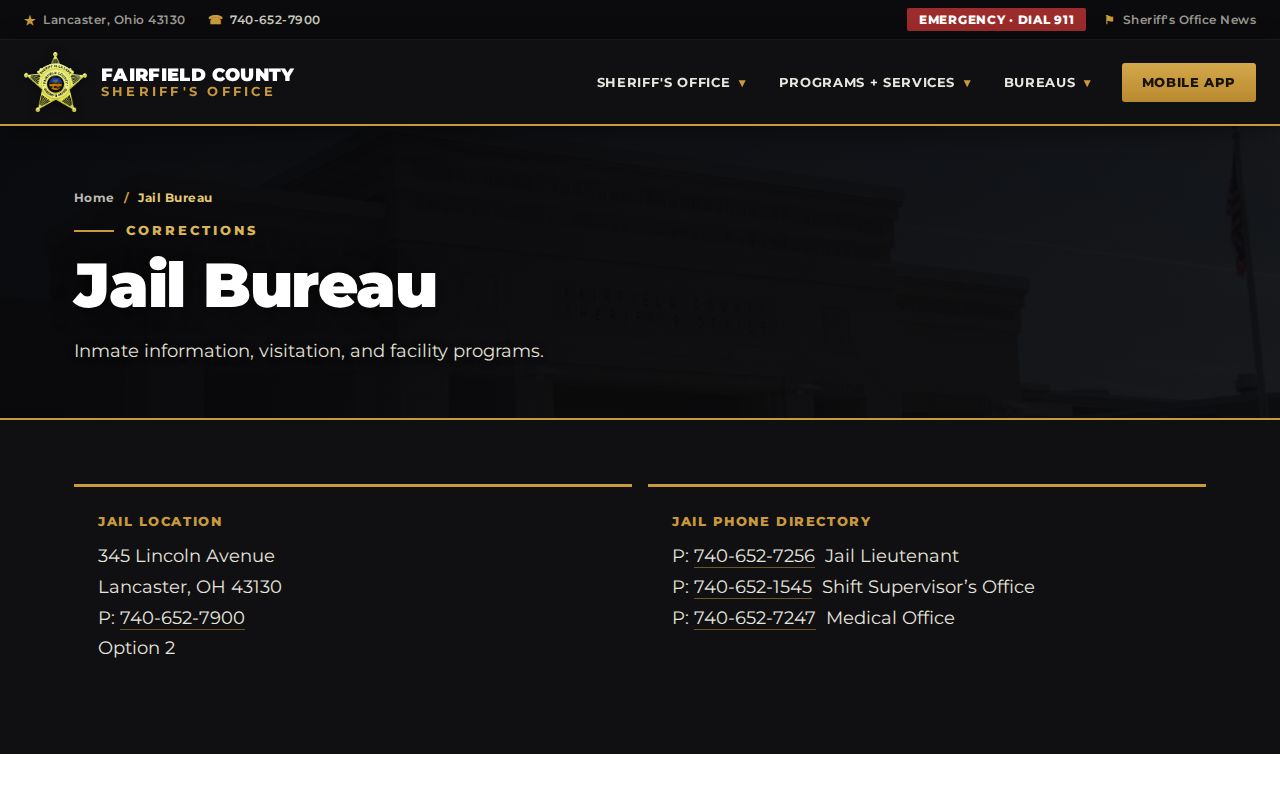
The page serves as a contact and facility gateway, not a searchable release archive.
Set Fairfield County Release Bounds
A rolling 72-hour request is measured backward from a fixed endpoint. A calendar three-day request may instead cover three named dates from midnight through midnight. Those are not the same dataset. Write the start and end date, clock time, and Eastern Time in the request. This prevents uncertainty at the edges and makes a later response easier to audit.
Weekend searches often cross both date and staffing boundaries. A Friday court order may be followed by later jail processing. A Monday docket search may also show hearings that did not cause release. The docket can locate the case and legal action, while the release log supplies the actual custody timestamp.
No Fairfield source establishes that a Sunday or holiday jail release shifts automatically to another day. Do not infer such a rule. Ask booking when the person physically left and whether another agency accepted custody.
Note: A 72-hour span should use one time zone and two exact endpoints, not vague terms such as “over the weekend.”
Check Fairfield County 72 Hour Releases
Begin with the custodian rather than a broad name-search site. Fairfield County Jail is the local source for the physical release event. Other official systems answer different parts of the question.
- Write the precise 72-hour interval in Eastern Time, including both dates and clock times.
- Contact Fairfield County jail/booking at 740-652-7317 or 740-652-7900, Option 2, for a named-person check.
- Ask Civil Bureau Records and Reports at 740-652-7320 for the existing release log or export covering that interval.
- Check Ohio VINE for each specific person and compare the custody event with jail confirmation.
- Use the Municipal Court search or Common Pleas eServices to identify the order or disposition.
- If the jail says transfer to state prison, search the ODRC Offender Search instead of calling it a community release.
VINE is a notification and custody-status layer. It can corroborate a reported event but may not explain bond, dismissal, time served, parole, or the receiving agency. Ohio officials advise users not to rely on VINE alone. Court entries are durable legal evidence, yet they may precede the jail's final discharge work.
For a same-day slice within the wider interval, use the Released Last 24 Hours method and give it its own exact endpoints.
Fairfield County 72 Hour Fields
Because there is no posted list, these are fields to request from an existing Fairfield County record, not fields claimed to appear online. Ask for only what helps distinguish each custody event.
| Field | Why it matters |
|---|---|
| Person name | Identifies the subject, with date of birth used separately when needed to resolve identity. |
| Booking number | Links the departure to the correct admission during a multi-day span. |
| Booking date/time | Shows when that county custody episode began. |
| Actual release date/time | Places the completed jail event inside or outside the requested 72-hour bounds. |
| Release disposition/type | Separates bond, recognizance, time served, court order, sentence completion, and transfer when recorded. |
| Authority or destination | Connects the event to a court or receiving custodian, subject to lawful redaction. |
Under Ohio R.C. 149.43, ask for the public record as maintained and request a redacted remainder if protected fields exist. The office need not create a new three-day compilation if its system does not keep one. No fixed county fee or response time for this record was found, so request electronic delivery and a cost estimate.
Fairfield County Release Roster Has No Archive
Many recent-release searches assume a person stays visible online for a set number of hours. Fairfield County has no public roster on which such a rule could operate. There is no supported claim that a release remains visible for one day, three days, or any other span. There is also no published online cadence to explain when an event would appear.
This unusually stark limit makes exact-interval records work more useful. Ask for the stored log, then use the result to identify people or bookings that need deeper confirmation. Do not replace the absent public archive with an unaffiliated mugshot page. An old commercial entry can survive long after the official record changes and cannot prove current release status.
A focused named-person request may be better than a list when the goal is one case. Provide full name, date of birth if known, approximate booking date, and case or booking number. Ask for the booking number, actual release date and time, disposition, releasing authority, and public transfer destination.
Note: No official online retention window exists to compare with a three-day search, so records staff must identify what stored record is available.
Fairfield Weekend Release Evidence
A three-day span is useful because it can bridge separate court days and capture the physical event after an earlier order. It does not fix source lag by itself. Read the chronological court docket, then compare the order date with the VINE event and jail release time. Small gaps may reflect ordinary processing, not conflicting records.
Municipal Court covers misdemeanor, traffic, and preliminary matters. Common Pleas handles felony indictments and judicial-release entries. A matter may begin in Municipal Court and continue under another number after bind-over, so follow docket references when the first search stops short of the final outcome.
“Closed” is an administrative case status, not an exit time. “Bond posted” can precede release processing. A sentence may direct transfer instead of release. Those distinctions matter more over three days because the interval can contain several hearings, orders, and custody changes for the same person.
Line up four points when the sources disagree: the court order date, VINE custody event, jail actual-release time, and any ODRC admission or release date. The sequence can show that a valid order came first, jail processing followed, and a later state record reflected transfer. It can also expose a wrong identity match. Do not force the dates to agree or choose the earliest one as the release time.
Fairfield Release Sources by Custodian
Fairfield County has two adult detention systems in Lancaster. The county jail belongs to the Sheriff. Southeastern Correctional Institution belongs to ODRC. A person sentenced in Fairfield County may be held at another state prison, while an SCI prisoner may have been sentenced by any Ohio county.
| Situation | Best source | Meaning |
|---|---|---|
| County jail community exit | Jail release record and court docket | Shows physical end of county custody and legal basis. |
| County jail transfer | Jail disposition and receiving agency | Fairfield custody ended, but custody continued. |
| State prisoner incarcerated | ODRC status and institution | A future date does not override current incarceration. |
| State prisoner under APA | ODRC APA supervision fields | Prison confinement ended while state supervision continues. |
| Federal or ICE movement | Federal custodian and court | State or county disappearance alone does not prove community release. |
For one named person, the complete search and release-record route begins at Home. A list request should stay focused on the three-day dataset rather than turning into an open-ended identity search.
Keep the original response and note which office supplied each field. A Municipal Court entry may explain bond or a misdemeanor sentence, while a Common Pleas entry may explain a felony sentence or judicial release. Neither source should be presented as the jail's actual three-day export. If dates differ slightly, ask the custodian whether the gap reflects processing.
A search result should also be matched by more than a name. Use a date of birth or age, booking or offender number, case number, and committing county when available. This reduces the chance that two people with similar names are combined in a single three-day account.
Federal and immigration sources are separate. A move to U.S. Marshals or ICE custody is not a community release merely because the county booking ended. The BOP locator applies after federal designation and ICE's locator shows current detention rather than a Fairfield release history. Use these channels only when the county disposition or court record points to that custodian.